
EPL1 fails.
What to check first.
// SHORT ANSWER
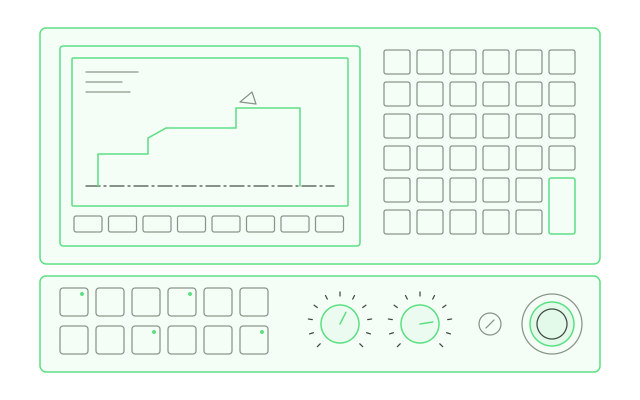
When a Heidenhain EPL1 control fails, in most cases the logic boards are not the problem — it is the NC backup battery, the 24V power supply or dry joints on the supply board. Before anything happens in the control cabinet, back up parameters and NC programs first.
// HEIDENHAIN EPL1 · SYMPTOM DIAGNOSIS
EPL1
// RESPONSE
UNDER 24 H
ON BUSINESS DAYS
IN PERSON
FROM A TECHNICIAN
// THE 3 MOST COMMON CAUSES
What is usually behind it.
NC backup battery at end of life
If the EPL1 no longer comes up after a voltage dip, or has lost parameters, the NC backup battery is the most common culprit. It holds memory and configuration while the machine is off power. A weak battery causes sporadic data loss and can announce itself for months before the control stops starting at all.
24V power supply or bridge rectifier faulty
EPL1 control cabinets from the 1990s use linear power supplies with electrolytic capacitors that reach the end of their life after 25-30 years. If the control does not start up at all, this is the second most likely cause. Measurement: check the 24V rail under load — it should sit stable at 24V ±5%.
Dry joint on the supply or CPU board
Sporadic behaviour — the control runs, drops out with no pattern, then runs again — almost always points to dry solder joints, usually at connectors, voltage regulators or buffer capacitors. Typical workshop pattern: thermal drift, worse as the cabinet warms up. The fix is re-soldering, not swapping the board.
// INITIAL CHECK
What you can
check yourself.
Before you remove or ship anything — these five steps are safe and give us the most important clues on the phone.
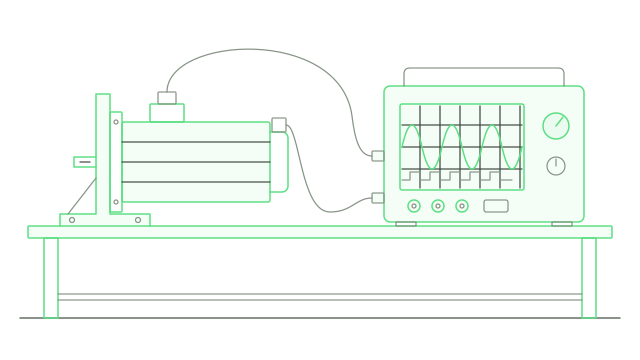
- 01 ·Note what the control shows: black screen? How far does it boot? Which LEDs are on / off / flashing? A photo of the LED status in the control cabinet helps us most.
- 02 ·If the control still reacts in part, back up parameters and NC programs via the serial interface. Data can be lost during any repair.
- 03 ·Check the visible fuses in the control cabinet (including the small fine 0.5-2A ones) — a blown fuse on the 24V supply is the simplest finding of all.
- 04 ·Feel (carefully, only on components that are not live!) whether any component gets unusually hot. Hot voltage regulators or electrolytic capacitors are a clear indication.
- 05 ·Note the machine model, the year of manufacture (on the type plate) and whether the control has shown anything unusual in recent months (data loss, sporadic dropouts). That history is worth its weight in gold when we narrow things down by phone.
// SHIPPING
Shipping to the US and worldwide
We ship EPL1 control boards and parts internationally, including to the United States — the carrier handles customs clearance, and we don't quote a fixed delivery time. Send us the symptom or a photo of the control cabinet and we'll check it by email or phone.
// FREQUENTLY ASKED QUESTIONS
What we are
often asked.
// 01
Can a discontinued EPL1 still be repaired?
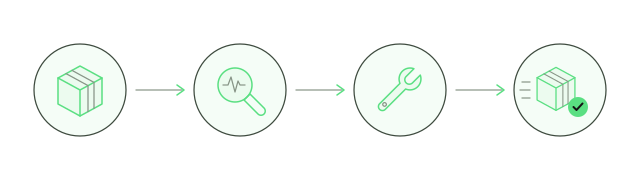
Yes. We repair EPL1 controls down to component level in our own workshop — even where the manufacturer has ended support. The most common defects (backup battery, power supply, dry joints, membrane keypad) are all manageable. What is beyond repair we replace from our archive.
// 02
How long does an EPL1 repair in the workshop take?
We can only state the exact effort after a visual inspection on the test bench. Pure backup battery problems are done in 1-2 business days; supply repairs typically take 5-10 business days. We discuss scope and delivery time with you by phone beforehand.
// 03
What does the repair cost?
At ESDI there are no flat-rate prices. Repair is diagnosis-driven — what really needs doing we see once the control is open. We discuss the scope with you before we repair.
// 04
Is an EPL1 repair still worth it — or is a new control the better option?
That depends on the machine and its remaining service life. From our workshop experience, a repaired EPL1 typically runs for another 5-10 years. A retrofit with a modern control costs a multiple of that and only makes sense if the machine is meant to keep running for a long time anyway. We tell you honestly what pays off.
// 05
Can you come on site as well?
Yes, in Ostwestfalen-Lippe and the wider North Rhine-Westphalia area. For simple findings, however, shipping the control to our workshop is usually faster and cheaper. We clarify that by phone.
// 06
Why should I not replace components myself?
Safety and warranty reasons: 24V power supplies carry dangerous DC link voltages. The wrong choice of component hides the follow-up fault. We open, measure, document and replace to original specification.
// SYMPTOM · INQUIRY
DESCRIBE THE
SYMPTOM.
The machine, what happened before the fault, what the control shows — one line is enough. We reply within 24h on business days, personally from a technician.
- Reply within 24h on business days
- Personally from a technician — no bots, no call centre
- Your inquiry never leaves our workshop
// RELATED TOPICS